
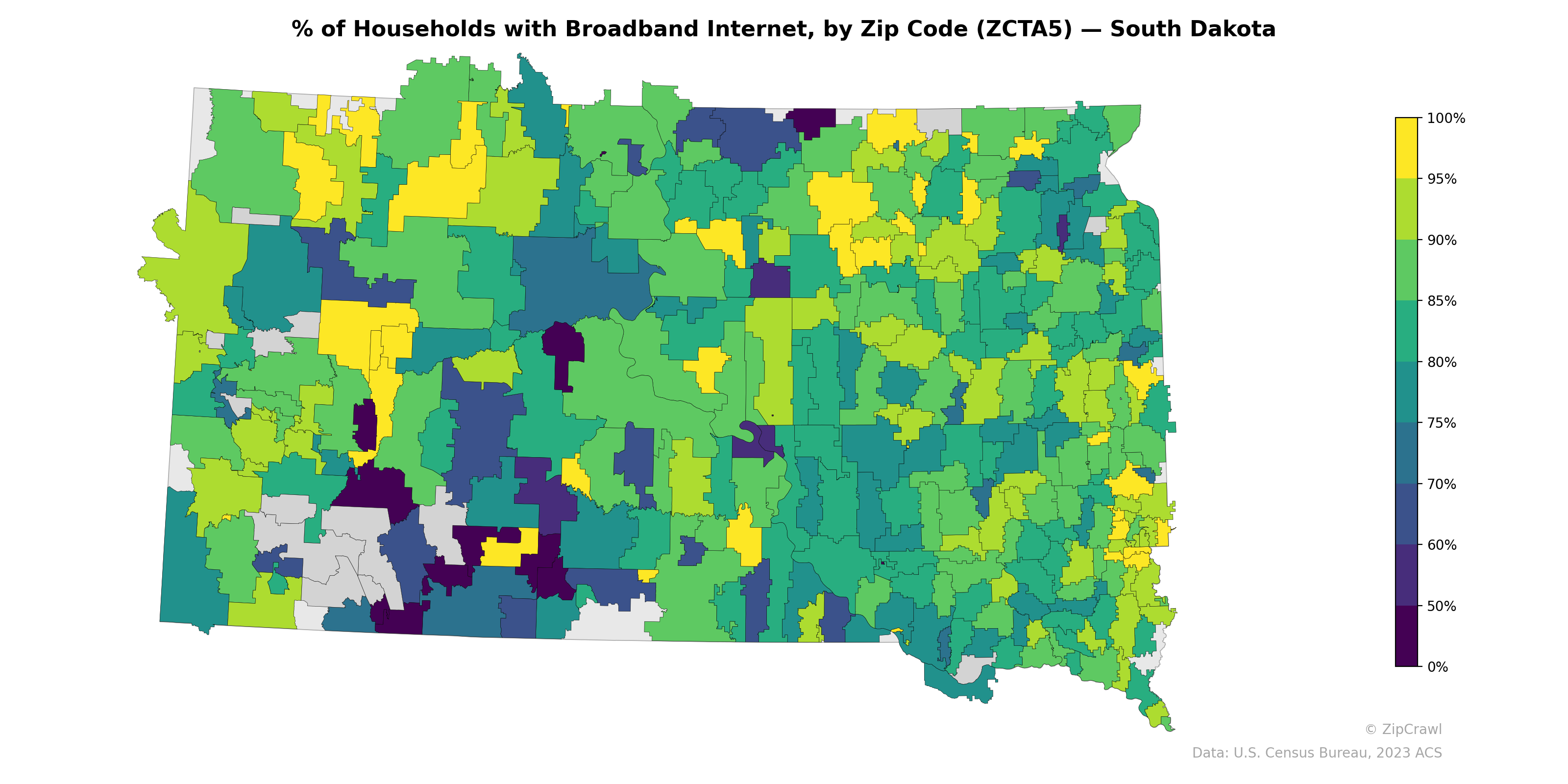
NOTE: Gray indicates insufficient data or a suppressed estimate.
Broadband adoption rates across South Dakota exhibit a stark urban-rural divide, with zip codes surrounding Sioux Falls in the southeast and the Rapid City area in the southwest generally achieving 85–95%+ coverage, while large swaths of the central and western regions—particularly areas overlapping tribal lands such as the Pine Ridge and Cheyenne River reservations—fall below 50%. A notable cluster of very low connectivity (dark purple, near 0–30%) is visible in the south-central part of the state, contrasting sharply with pockets of near-universal broadband access (bright yellow) scattered among smaller communities in the northeast and along the I-29 corridor. The northwestern quadrant displays considerable heterogeneity, with adjacent zip codes often differing by 20–30 percentage points, suggesting that broadband infrastructure investment has been highly uneven at the local level.
Data: U.S. Census Bureau, 2023 ACS
Explore
- Housing Owner-Occupied Median Value ($), by Zip Code (ZCTA5) — New York
- Housing Owner-Occupied % of Units, by Zip Code (ZCTA5) — South Dakota
- Housing Median Monthly Rent ($), by Zip Code (ZCTA5) — South Dakota
- % of Population without Health Insurance, by Zip Code (ZCTA5) — South Dakota
- Household Average Size by Zip Code (ZCTA5) — South Dakota
- Housing % of Units Built Since 2010, by Zip Code (ZCTA5) — South Dakota
- Housing Owner-Occupied Median Value ($), by Zip Code (ZCTA5) — South Dakota
- Bachelor's Degree or Higher (% of Over 25) by Zip Code (ZCTA5) — South Dakota
- High School Graduate (% of Over 25) by Zip Code (ZCTA5) — South Dakota
- Population Non-Hispanic American Indian % by Zip Code (ZCTA5) — South Dakota
- Household Average Size by County
- Household Median Income by Zip Code (ZCTA5) — Indiana
- Household Average Size by Zip Code (ZCTA5) — New York
- Married Couple (% of all Households) by Zip Code (ZCTA5) — New York
- Housing Owner-Occupied % of Units, by Zip Code (ZCTA5) — New York
- % of Population without Health Insurance, by Zip Code (ZCTA5) — New York
- Housing Median Monthly Rent ($), by Zip Code (ZCTA5) — New York
- Housing Vacancy Rate by Zip Code (ZCTA5) — New York
- Household Median Income by Zip Code (ZCTA5) — New York
- Bachelor's Degree or Higher (% of Over 25) by Zip Code (ZCTA5) — New York
- Housing % of Units Built Since 2010, by Zip Code (ZCTA5) — New York
- High School Graduate (% of Over 25) by Zip Code (ZCTA5) — Rhode Island
- Population Non-Hispanic American Indian % by Zip Code (ZCTA5) — North Dakota
- Housing Vacancy Rate by Zip Code (ZCTA5) — Rhode Island
- U.S. Citizens (% of Population Over 18) by Zip Code (ZCTA5) — Oregon
- Bachelor's Degree or Higher (% of Over 25) by Zip Code (ZCTA5) — Rhode Island
- Population Non-Hispanic Black % by Zip Code (ZCTA5) — North Dakota
- Housing Vacancy Rate by Zip Code (ZCTA5) — Alaska
- Population Non-Hispanic American Indian % by Zip Code (ZCTA5) — Rhode Island
- Married Couple (% of all Households) by Zip Code (ZCTA5) — Rhode Island
- % of Households with Broadband Internet, by Zip Code (ZCTA5) — North Dakota
- % of Households with Broadband Internet, by Zip Code (ZCTA5) — South Carolina
- % of Households with Broadband Internet, by Zip Code (ZCTA5) — Iowa
- % of Households with Broadband Internet, by Zip Code (ZCTA5) — Ohio
- % of Households with Broadband Internet, by Zip Code (ZCTA5) — Utah
- % of Households with Broadband Internet, by Zip Code (ZCTA5) — Idaho
- % of Households with Broadband Internet, by Zip Code (ZCTA5) — Minnesota
- % of Households with Broadband Internet, by Zip Code (ZCTA5) — Oregon
- % of Households with Broadband Internet, by Zip Code (ZCTA5) — Texas
- % of Households with Broadband Internet, by Zip Code (ZCTA5) — Indiana